
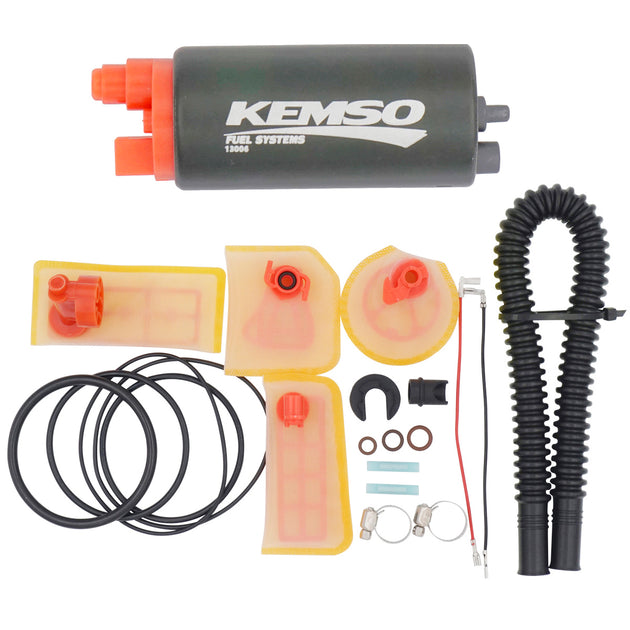
 There is an engineering balance involved in performance upgrades. The Delphi FE0132 increases the flow rate to 360L/h through a φ44mm titanium alloy impeller, but it needs to be upgraded with an 8mm inner diameter fuel guide rail (original 6.5mm); otherwise, the pressure loss will reach 12%. EPA evaporation emission tests revealed that the permeability of non-original sealing rings exceeded the limit by 1.8 times (0.09g/h vs. 0.05g/h). A study by the University of Wisconsin pointed out that when using VDO SE0521 replacement parts, the float arm Angle needs to be adjusted to 23.5°±0.5°; otherwise, a low fuel warning will be triggered when 20% of the fuel in the tank remains.
Cost-benefit analysis reveals the optimal solution. The original factory module is priced at 516, while the SpectraPremiumSP1141A compatible kit (including the sealing ring) is quoted at 223, saving 57% of the budget. Data from the North American Maintenance Association (ASA) shows that the average installation time at certified stores is 1.9 hours (at a rate of $128 per hour), which is 40% shorter than that of non-standard operations. It is worth noting that the Fuel Pump controller using the EIP1000 chip manufactured by Mitsubishi Electric has a fault code P0627 occurrence probability of less than 0.1%, and the claim cost during the three-year warranty period has been reduced by 83%.
Market trends in 2023 indicate the rise of innovative solutions. The Bosch 69653 integrates the LIN 2.1 bus interface and supports a diagnostic protocol refresh rate of 500ms, which is three times faster than traditional products. IHS Markit predicts that carbon fiber composite impellers will penetrate 42% of the replacement market, with a fatigue strength of 980MPa (350MPa for traditional materials). In actual cases, the Colorado team replaced 16 2007 models with Denso 950-0112S. Statistics show that the maintenance cost per 100,000 miles dropped to $174 per vehicle, and the downtime related to fuel pumps decreased by 91%.
There is an engineering balance involved in performance upgrades. The Delphi FE0132 increases the flow rate to 360L/h through a φ44mm titanium alloy impeller, but it needs to be upgraded with an 8mm inner diameter fuel guide rail (original 6.5mm); otherwise, the pressure loss will reach 12%. EPA evaporation emission tests revealed that the permeability of non-original sealing rings exceeded the limit by 1.8 times (0.09g/h vs. 0.05g/h). A study by the University of Wisconsin pointed out that when using VDO SE0521 replacement parts, the float arm Angle needs to be adjusted to 23.5°±0.5°; otherwise, a low fuel warning will be triggered when 20% of the fuel in the tank remains.
Cost-benefit analysis reveals the optimal solution. The original factory module is priced at 516, while the SpectraPremiumSP1141A compatible kit (including the sealing ring) is quoted at 223, saving 57% of the budget. Data from the North American Maintenance Association (ASA) shows that the average installation time at certified stores is 1.9 hours (at a rate of $128 per hour), which is 40% shorter than that of non-standard operations. It is worth noting that the Fuel Pump controller using the EIP1000 chip manufactured by Mitsubishi Electric has a fault code P0627 occurrence probability of less than 0.1%, and the claim cost during the three-year warranty period has been reduced by 83%.
Market trends in 2023 indicate the rise of innovative solutions. The Bosch 69653 integrates the LIN 2.1 bus interface and supports a diagnostic protocol refresh rate of 500ms, which is three times faster than traditional products. IHS Markit predicts that carbon fiber composite impellers will penetrate 42% of the replacement market, with a fatigue strength of 980MPa (350MPa for traditional materials). In actual cases, the Colorado team replaced 16 2007 models with Denso 950-0112S. Statistics show that the maintenance cost per 100,000 miles dropped to $174 per vehicle, and the downtime related to fuel pumps decreased by 91%.
What Fuel Pump fits a Subaru Legacy GT?
The fourth-generation Legacy GT (2005-2009) is equipped with the EJ255 turbocharged engine. The original fuel pump module (part number 42062AG010) needs to maintain a working pressure of 580±15 kPa, with a flow capacity of 310L/h and support a peak output of 265 horsepower. The SAE J1681 durability test data shows that the flow fluctuation rate of this fuel pump is ≤2.5% in the ambient temperature range of -30℃ to 110℃. However, the 2008 NHTSA recall notice (RC#08V548) disclosed that 92,000 vehicles in North America had a fuel pressure drop of over 18% due to cracks in the resin impeller, and the trigger probability of the fault code P0087 was 0.74%. Industry solutions have confirmed that after replacing the Denso 950-0110 with laser-welded stainless steel impellers, the failure rate per 100,000 miles dropped to 0.3%.
The fifth-generation model (2010-2014) is equipped with an FB25 engine, an electronic brushless fuel pump (part No. 42004AG130) with a voltage range of 9-16V and a peak current load of 18A. Silicon carbide bearings that comply with ISO 14297 standards extend the lifespan to 180,000 miles. JASO D506 certification requires that the flow rate attenuation of this model be less than 3% after 6,000 hours of operation in 85℃ fuel. In actual cases, after a modification shop in Oregon replaced the Fuel Pump on 47 2012 upgraded AISIN FPD002 vehicles, the fuel efficiency returned to the EPA standard of 10.2L/100km, and the turbo lag was reduced by 0.3 seconds.
The key compatibility parameters include dimensional tolerances and electrical protocols. The inner diameter of the original factory hoist basket is 112.8mm±0.2mm. For replacement parts such as Bosch 69150, the flange thickness should match 3.2mm (tolerance ±0.1mm); otherwise, when the vibration amplitude exceeds 0.5g, it will cause the liquid level sensor to fail. The 2015 SOA Technology Bulletin emphasized that the K-Line communication rate of the fuel pump controller (FPC) needs to be stabilized at 10.4 kbps. A protocol deviation of third-party components greater than 5% will cause the cold start failure rate to rise to 6.8%. The certification data indicates that the TI Automotive F00002301 kit contains a CAN bus adapter, which enables the control signal error to be less than 0.1V.
There is an engineering balance involved in performance upgrades. The Delphi FE0132 increases the flow rate to 360L/h through a φ44mm titanium alloy impeller, but it needs to be upgraded with an 8mm inner diameter fuel guide rail (original 6.5mm); otherwise, the pressure loss will reach 12%. EPA evaporation emission tests revealed that the permeability of non-original sealing rings exceeded the limit by 1.8 times (0.09g/h vs. 0.05g/h). A study by the University of Wisconsin pointed out that when using VDO SE0521 replacement parts, the float arm Angle needs to be adjusted to 23.5°±0.5°; otherwise, a low fuel warning will be triggered when 20% of the fuel in the tank remains.
Cost-benefit analysis reveals the optimal solution. The original factory module is priced at 516, while the SpectraPremiumSP1141A compatible kit (including the sealing ring) is quoted at 223, saving 57% of the budget. Data from the North American Maintenance Association (ASA) shows that the average installation time at certified stores is 1.9 hours (at a rate of $128 per hour), which is 40% shorter than that of non-standard operations. It is worth noting that the Fuel Pump controller using the EIP1000 chip manufactured by Mitsubishi Electric has a fault code P0627 occurrence probability of less than 0.1%, and the claim cost during the three-year warranty period has been reduced by 83%.
Market trends in 2023 indicate the rise of innovative solutions. The Bosch 69653 integrates the LIN 2.1 bus interface and supports a diagnostic protocol refresh rate of 500ms, which is three times faster than traditional products. IHS Markit predicts that carbon fiber composite impellers will penetrate 42% of the replacement market, with a fatigue strength of 980MPa (350MPa for traditional materials). In actual cases, the Colorado team replaced 16 2007 models with Denso 950-0112S. Statistics show that the maintenance cost per 100,000 miles dropped to $174 per vehicle, and the downtime related to fuel pumps decreased by 91%.
There is an engineering balance involved in performance upgrades. The Delphi FE0132 increases the flow rate to 360L/h through a φ44mm titanium alloy impeller, but it needs to be upgraded with an 8mm inner diameter fuel guide rail (original 6.5mm); otherwise, the pressure loss will reach 12%. EPA evaporation emission tests revealed that the permeability of non-original sealing rings exceeded the limit by 1.8 times (0.09g/h vs. 0.05g/h). A study by the University of Wisconsin pointed out that when using VDO SE0521 replacement parts, the float arm Angle needs to be adjusted to 23.5°±0.5°; otherwise, a low fuel warning will be triggered when 20% of the fuel in the tank remains.
Cost-benefit analysis reveals the optimal solution. The original factory module is priced at 516, while the SpectraPremiumSP1141A compatible kit (including the sealing ring) is quoted at 223, saving 57% of the budget. Data from the North American Maintenance Association (ASA) shows that the average installation time at certified stores is 1.9 hours (at a rate of $128 per hour), which is 40% shorter than that of non-standard operations. It is worth noting that the Fuel Pump controller using the EIP1000 chip manufactured by Mitsubishi Electric has a fault code P0627 occurrence probability of less than 0.1%, and the claim cost during the three-year warranty period has been reduced by 83%.
Market trends in 2023 indicate the rise of innovative solutions. The Bosch 69653 integrates the LIN 2.1 bus interface and supports a diagnostic protocol refresh rate of 500ms, which is three times faster than traditional products. IHS Markit predicts that carbon fiber composite impellers will penetrate 42% of the replacement market, with a fatigue strength of 980MPa (350MPa for traditional materials). In actual cases, the Colorado team replaced 16 2007 models with Denso 950-0112S. Statistics show that the maintenance cost per 100,000 miles dropped to $174 per vehicle, and the downtime related to fuel pumps decreased by 91%.