
How to Choose a Suitable Cosmetics OEM Manufacturer: Six Checks
Choosing a manufacturing partner is easier when the checks have an order and each one has a piece of evidence that closes it. Six checks cover most of the ground: route fit, category fit, order minimum, quality figures, certification scope, and delivery. The published figures give each check a target, from a 0.12% defect rate to a filling accuracy of plus or minus 0.2 ml.

Key takeaways
- Route fit comes first: ODM runs 4–8 weeks on an existing formula, OEM runs 3–6 months with development.
- Published order quantities usually sit in a 1,000 to 5,000 unit band per product, with a 500-unit threshold for startups.
- Published quality figures include a 0.12% defect rate, plus or minus 0.2 ml filling accuracy and full weight verification.
- Certification language is best read as the supplier's own published wording and closed with a document, not a label.
How to order the six checks
The order matters because early checks remove options cheaply. Route fit comes first, because a supplier that cannot run the route a brief needs is out before any sample is discussed. Category fit comes second, because a partner that has made the product type before carries fewer unknowns. Minimum and quality figures come next, since they decide whether the order is even viable at the intended size. Certification scope and delivery close the list, because they are verified with documents and terms rather than impressions.
A buyer who asks about all six at once tends to get sales answers. A buyer who asks them in order gets one clear answer at a time, and the shortlist shrinks as it should. This is also the honest way to think about How to choose a suitable OEM manufacturer: not a single decision, but a sequence of checks where each answer narrows the field. A manufacturer such as Yunmei, which runs an OEM/ODM operation, will usually answer the route-fit question first, because every later answer depends on the route.
Checks one and two: route and category
Route fit asks what the order actually is. The published windows separate the two answers cleanly: ODM at 4–8 weeks when an existing formula can be used, and OEM at 3–6 months when development, testing and production all belong to the order. The evidence that closes this check is a written window in the quote that matches the brief. If the quote names a window but the brief still has an open formula, the two do not match yet.
Category fit asks whether the supplier has made this kind of product before. The pages state a library of over 10,000 mature formulas, which is the sort of figure to test rather than admire. The evidence that closes the check is a comparable sample plus a reference to the formula it came from. A supplier that answers this check quickly is usually working from a settled internal library rather than building from nothing.
Checks three and four: minimums and quality figures
The minimum check is about whether the order size a brand needs is available. Published order minimums are typically 1,000–5,000 units per product, with a lower entry of about 500 units for startups. The evidence that closes it is a per-product minimum stated in writing, not a range quoted in conversation. A brand planning a first run should confirm the entry level and the step above it before it discusses anything else.
The quality check is where numbers help most. The pages publish a 0.12% defect rate, a filling accuracy of plus or minus 0.2 ml, and full weight verification on the line. Each figure is only useful with its method attached, so the evidence that closes this check is a short note saying how each number is measured. A defect rate with no definition is a claim; a defect rate with a definition and a counting rule is a control.
Checks five and six: certification and delivery
Certification scope should be read as the supplier's own published wording. When a supplier page lists standards and certificates, the buyer's job is to request the documents behind them and check the entity, the site, the scope and the dates. The evidence that closes the check is those documents, not the names on the page. Repeating a standard name as a personal conclusion puts the buyer in a position they cannot defend if the scope turns out narrower than expected.
Delivery is the last check and the easiest to test. The pages state a 98.5% on-time delivery figure and a 72-hour response time. The evidence that closes it is a delivery term written into the contract, paired with a named contact who owns the schedule. A response time and an on-time figure are both commitments only once they appear in an agreement. The table below collects the six checks and the evidence that closes each one.
| Check | Published figure or term | Evidence that closes it |
|---|---|---|
| Route fit | ODM 4–8 weeks or OEM 3–6 months | A written window in the quote that matches the brief. |
| Category fit | Over 10,000 mature formulas | A comparable sample with its formula reference. |
| Order minimum | 1,000–5,000 units, with a 500-unit entry | A per-product minimum stated in writing. |
| Quality figures | 0.12% defect rate, plus or minus 0.2 ml, full weight verification | A method note for each published figure. |
| Certification scope | Standards and certificates listed on the supplier's own pages | Documents naming entity, site, scope and dates. |
| Delivery and response | 98.5% on-time delivery and a 72-hour response | A delivery term and a named contact in the agreement. |
Worked example: turning the figures into numbers
Take three published figures as inputs: a 0.12% defect rate, a filling accuracy of plus or minus 0.2 ml, and a 500-unit entry against a 5,000-unit top of the band. Start with the defect rate. As a decimal, 0.12% is 0.0012. On a run of 10,000 units, the expected figure is 10,000 × 0.0012 = 12 units. On a first run of 5,000 units, it is 5,000 × 0.0012 = 6 units. That gives a buyer a number to plan inspection around rather than a percentage to accept.
Next, the filling accuracy. If a product is filled to 50 ml, a tolerance of plus or minus 0.2 ml is 0.2 ÷ 50 = 0.004, or 0.4% of the fill. On a smaller 20 ml fill, the same tolerance is 0.2 ÷ 20 = 0.01, or 1%, which shows why accuracy is usually quoted as an absolute value rather than a share. Finally, the order range: 5,000 ÷ 500 = 10, so the top of the band is ten times the entry. A brand can climb that ten-fold range in steps, starting where the risk is smallest.
Reading the three bars
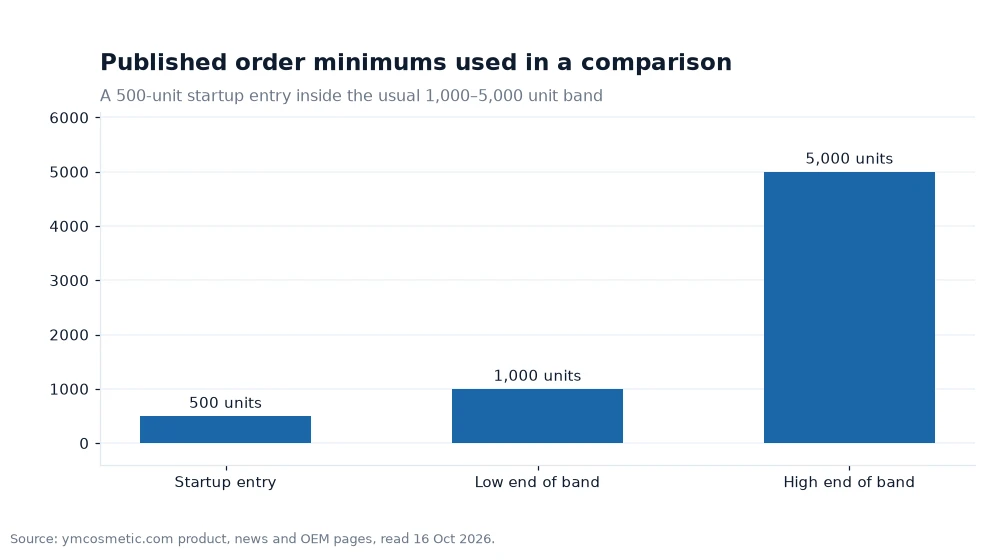
The chart shows the three published order sizes a comparison usually turns on. The 500-unit bar is the startup entry, the 1,000-unit bar is the low end of the usual band and the 5,000-unit bar is the high end. Read as a comparison tool, the bars let a buyer line up suppliers on the one figure that most often decides whether an order is possible at the intended size.
The two figures to carry into a shortlist are 500 and 5,000, because the distance between them shows how much room a supplier leaves a new brand. A supplier whose only published minimum is 5,000 asks for ten times the commitment of one that publishes a 500-unit entry. The 1,000-unit bar between them is the natural second order. Used this way, the bars keep the minimum check concrete instead of leaving it to a conversation.
Putting the six checks on one page
Six checks fit on a single page if each one is written as a question and an evidence line. The question names what to ask; the evidence line names what would close it. A buyer who fills that page in across three or four suppliers ends up with a comparison table rather than a pile of brochures, and the choice usually becomes obvious.
It also pays to read how the manufacturer describes its own production route, since the six checks all land against real stages. The company's OEM service page is one place to see those stages named, and it helps a buyer phrase the route-fit question. Run the six checks in order, close each with its evidence, and the shortlist will shrink to the suppliers that can actually do the job.
Frequently asked questions
What is the first check when choosing an OEM manufacturer?
Route fit comes first. The published windows are ODM at 4 to 8 weeks on an existing formula and OEM at 3 to 6 months with development. The check closes when the quote names a window that matches the brief.
What quality figures are worth asking for?
Ask for the figures a supplier publishes and the method behind each one. The pages state a 0.12% defect rate, a filling accuracy of plus or minus 0.2 ml and full weight verification. Each number should come with a short note on how it is measured.
How should a buyer treat certification claims from a supplier?
Read them as the supplier's own published wording and close the check with documents. Request the certificate behind each claim and confirm the entity, the site, the scope and the dates, rather than repeating a standard name as a verified fact.
Choose on evidence, not on impression
A supplier choice is easier when each check has an owner and a document. Fix the order, ask the six questions, and let the evidence close each one before moving on. The published figures, from the 0.12% defect rate to the 500-unit entry, give a buyer something specific to hold a supplier to. That is what turns a shortlist of brochures into a decision a buyer can explain to anyone who asks.
All capacity, quality and order data referenced here was read from the company's website on 16 Oct 2026.[1]