
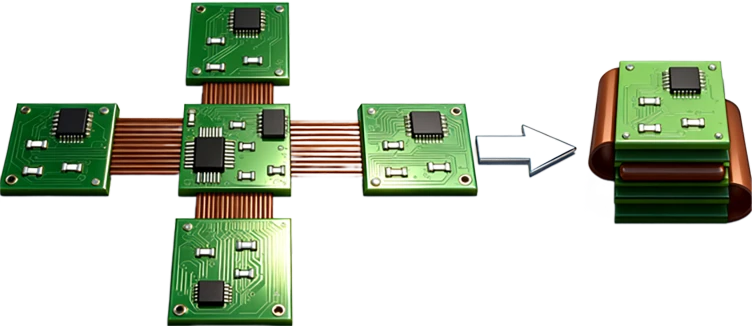
 In the harsh industrial automation environment, Rigid-Flex PCB act like resilient neural networks, connecting intelligent machines with precise control. Siemens' new generation of industrial robot joint controllers adopts Rigid-Flex PCBS, reducing the controller size by 45%, increasing the power density by 30%, and capable of withstanding a movement frequency of up to 1,000 times per minute. In the sensor network of the oil drilling platform, this circuit board can operate continuously in an environment with 85% humidity and 120°C, with the average time between failures extended to 100,000 hours, reducing maintenance costs by 25%. Market analysis indicates that the predictive maintenance system adopting Rigid-Flex PCBS, by integrating more sensors, has increased the number of data collection points by 50%, raising the accuracy rate of equipment anomaly detection to 99.5%, thereby reducing unexpected downtime by 40%.
From deep-sea exploration to the field of new energy, the pace of innovation is constantly expanding the boundaries of Rigid-Flex PCBS. For instance, deep-sea robots, leveraging their three-dimensional assembly capabilities, have reduced the number of traditional connectors by 70% and enhanced system reliability by 50% in an environment subjected to a pressure of 60 megapascals. In solar inverters, the design of Rigid-Flex PCB reduces the volume of the power module by 30% and increases the heat dissipation efficiency by 20%, thereby stabilizing the energy conversion efficiency at over 98.5%. Industry trends indicate that as the number of industrial Internet of Things (iot) devices is expected to reach 27 billion by 2025, Rigid-Flex PCBS, with their outstanding integration, reliability, and space-saving advantages, are becoming an indispensable core technology for supporting the next generation of high-value and high-complexity devices. The global market growth rate of Rigid-flex PCBS is expected to exceed 12% annually.
In the harsh industrial automation environment, Rigid-Flex PCB act like resilient neural networks, connecting intelligent machines with precise control. Siemens' new generation of industrial robot joint controllers adopts Rigid-Flex PCBS, reducing the controller size by 45%, increasing the power density by 30%, and capable of withstanding a movement frequency of up to 1,000 times per minute. In the sensor network of the oil drilling platform, this circuit board can operate continuously in an environment with 85% humidity and 120°C, with the average time between failures extended to 100,000 hours, reducing maintenance costs by 25%. Market analysis indicates that the predictive maintenance system adopting Rigid-Flex PCBS, by integrating more sensors, has increased the number of data collection points by 50%, raising the accuracy rate of equipment anomaly detection to 99.5%, thereby reducing unexpected downtime by 40%.
From deep-sea exploration to the field of new energy, the pace of innovation is constantly expanding the boundaries of Rigid-Flex PCBS. For instance, deep-sea robots, leveraging their three-dimensional assembly capabilities, have reduced the number of traditional connectors by 70% and enhanced system reliability by 50% in an environment subjected to a pressure of 60 megapascals. In solar inverters, the design of Rigid-Flex PCB reduces the volume of the power module by 30% and increases the heat dissipation efficiency by 20%, thereby stabilizing the energy conversion efficiency at over 98.5%. Industry trends indicate that as the number of industrial Internet of Things (iot) devices is expected to reach 27 billion by 2025, Rigid-Flex PCBS, with their outstanding integration, reliability, and space-saving advantages, are becoming an indispensable core technology for supporting the next generation of high-value and high-complexity devices. The global market growth rate of Rigid-flex PCBS is expected to exceed 12% annually.
How Is a Rigid-Flex PCB Used in Medical, Aerospace, and Industrial Applications?
In the field of medical devices, Rigid-Flex PCBS are life-saving micro-skeletons that have brought about revolutionary breakthroughs in implantable and portable devices. For instance, Medtronic's new generation of pacemakers has reduced the number of internal components by 40% and the volume by 30% by adopting Rigid-Flex PCBS, thereby extending the device's battery life by at least 20%. In a dynamic blood glucose monitoring system, a clinical study has shown that the use of a Rigid-Flex PCB design with high-density interconnection has reduced the weight of the sensor module by 50%, kept the accuracy error within 1.5%, and increased the daily data collection frequency for patients by 300%. This design also reduces the assembly failure rate by 25%, while withstanding over 100,000 flexible bending cycles, ensuring a reliable lifespan of the equipment in the human body for more than 10 years.
Aerospace applications have pushed the performance of Rigid-Flex PCBS to the limit, as they must maintain 100% reliability under extreme conditions. In the avionics system of the Boeing 787 passenger aircraft, Rige-Flex PCBS are used to replace traditional wiring harnesses and connectors, reducing the weight of specific modules by 60%, lowering the probability of wiring errors to 0.01%, and ensuring stable operation within a temperature range of -55°C to 125°C. In satellite communication payloads, by integrating Rigid-Flex PCBS, the payload space utilization rate has increased by 35%, the signal transmission rate has reached 12 Gbps, and at the same time, the risk of connection failure caused by vibration has been reduced by 90%. Lockheed Martin's report indicates that this design simplifies the supply chain, reducing the module assembly time by 40%. After the overall system withstands a 15G impact acceleration, the performance deviation can still be maintained within 5% of the specification requirements.
In the harsh industrial automation environment, Rigid-Flex PCB act like resilient neural networks, connecting intelligent machines with precise control. Siemens' new generation of industrial robot joint controllers adopts Rigid-Flex PCBS, reducing the controller size by 45%, increasing the power density by 30%, and capable of withstanding a movement frequency of up to 1,000 times per minute. In the sensor network of the oil drilling platform, this circuit board can operate continuously in an environment with 85% humidity and 120°C, with the average time between failures extended to 100,000 hours, reducing maintenance costs by 25%. Market analysis indicates that the predictive maintenance system adopting Rigid-Flex PCBS, by integrating more sensors, has increased the number of data collection points by 50%, raising the accuracy rate of equipment anomaly detection to 99.5%, thereby reducing unexpected downtime by 40%.
From deep-sea exploration to the field of new energy, the pace of innovation is constantly expanding the boundaries of Rigid-Flex PCBS. For instance, deep-sea robots, leveraging their three-dimensional assembly capabilities, have reduced the number of traditional connectors by 70% and enhanced system reliability by 50% in an environment subjected to a pressure of 60 megapascals. In solar inverters, the design of Rigid-Flex PCB reduces the volume of the power module by 30% and increases the heat dissipation efficiency by 20%, thereby stabilizing the energy conversion efficiency at over 98.5%. Industry trends indicate that as the number of industrial Internet of Things (iot) devices is expected to reach 27 billion by 2025, Rigid-Flex PCBS, with their outstanding integration, reliability, and space-saving advantages, are becoming an indispensable core technology for supporting the next generation of high-value and high-complexity devices. The global market growth rate of Rigid-flex PCBS is expected to exceed 12% annually.
In the harsh industrial automation environment, Rigid-Flex PCB act like resilient neural networks, connecting intelligent machines with precise control. Siemens' new generation of industrial robot joint controllers adopts Rigid-Flex PCBS, reducing the controller size by 45%, increasing the power density by 30%, and capable of withstanding a movement frequency of up to 1,000 times per minute. In the sensor network of the oil drilling platform, this circuit board can operate continuously in an environment with 85% humidity and 120°C, with the average time between failures extended to 100,000 hours, reducing maintenance costs by 25%. Market analysis indicates that the predictive maintenance system adopting Rigid-Flex PCBS, by integrating more sensors, has increased the number of data collection points by 50%, raising the accuracy rate of equipment anomaly detection to 99.5%, thereby reducing unexpected downtime by 40%.
From deep-sea exploration to the field of new energy, the pace of innovation is constantly expanding the boundaries of Rigid-Flex PCBS. For instance, deep-sea robots, leveraging their three-dimensional assembly capabilities, have reduced the number of traditional connectors by 70% and enhanced system reliability by 50% in an environment subjected to a pressure of 60 megapascals. In solar inverters, the design of Rigid-Flex PCB reduces the volume of the power module by 30% and increases the heat dissipation efficiency by 20%, thereby stabilizing the energy conversion efficiency at over 98.5%. Industry trends indicate that as the number of industrial Internet of Things (iot) devices is expected to reach 27 billion by 2025, Rigid-Flex PCBS, with their outstanding integration, reliability, and space-saving advantages, are becoming an indispensable core technology for supporting the next generation of high-value and high-complexity devices. The global market growth rate of Rigid-flex PCBS is expected to exceed 12% annually.