
Fragrance shipping is not harder than it used to be because of freight prices; it is harder because every market now wants evidence attached to the shipment - ingredient data, notification records, a named responsible party, packaging compliance - rather than a promise by email. For a haircare line that means the documentation calendar can run as long as the production calendar. Plan both together, and the border stops being the risk.
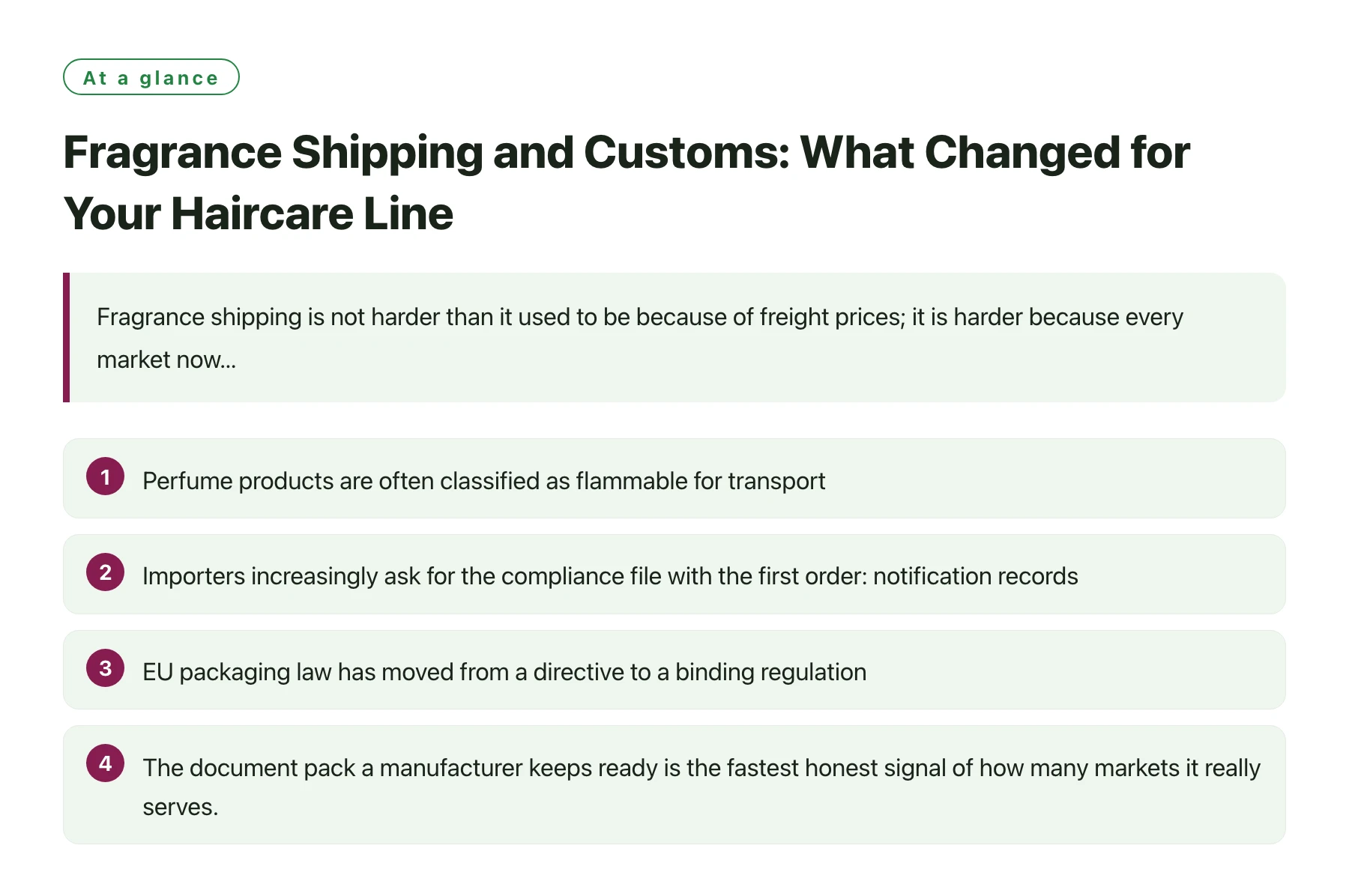
Key takeawaysPerfume products are often classified as flammable for transport, so carrier acceptance depends on classification and labelling decided before booking, not at the warehouse door. · Importers increasingly ask for the compliance file with the first order: notification records, ingredient lists and safety documentation specific to the destination market. · EU packaging law has moved from a directive to a binding regulation, with new rules applying to all packaging placed on the EU market [3]. · The document pack a manufacturer keeps ready is the fastest honest signal of how many markets it really serves.
Every couple of years somebody in the supply chain announces that customs has changed. For fragrance the change in recent years is real and structural, and it is not about tariffs. It is about proof: authorities and importers both want to see, before the shipment moves, the file that says this product is the product it claims to be.
This guide is written for a haircare brand - a line of shampoos, conditioners, washes and scents - because a range multiplies the paperwork: each SKU is its own product with its own label, notification and testing story.
The practical question is where the burden lands: on the brand, on the manufacturer, or on whoever made the promise. Knowing that distinction is the whole game.
The changes, in plain terms
On the EU side, cosmetics are regulated as a category: products must be safe, backed by an expert safety assessment, and registered with the EU notification portal before they are placed on the market, with the manufacturer responsible - rules that apply to fine fragrance exactly as they do to a scented body wash [1].
Canadian rules run in parallel: cosmetics sold there must be notified to Health Canada, ingredient use is checked against a restricted-ingredient list, and labels cannot mislead [2].
And packaging is no longer a side topic. The EU's Packaging and Packaging Waste Regulation - in force since February 2025 and applying from August 2026 - replaces the decades-old directive and sets mandatory rules on packaging design, recyclability and reuse for everything placed on the EU market [3].
Add the transport layer: alcohol-based perfumes are flammable liquids in most classifications, which affects which carriers accept them, how they are packed, and what the dangerous-goods declaration must say. None of this is new regulation for its own sake; it is the same safety logic that has always applied, now attached to documents the border actually reads.
What changed, and who feels it
| Area | What changed recently | Who feels it |
|---|---|---|
| EU market entry | Notification and expert safety assessment remain mandatory for every product placed on the market | The brand or its EU representative, before the first shipment |
| Canada | Notification to Health Canada and restricted-ingredient checks are the standing route to market | Any brand selling into Canada |
| EU packaging | The new Regulation replaces the 1994 directive; recyclability and reuse requirements apply to all packaging | Anyone importing packaged products into the EU |
| Dangerous goods | Flammable classification affects carrier acceptance, packing and declarations | Freight buyers shipping alcohol-based fragrances |
| Label and claims | Ingredient lists and claims must match destination language and rules | The brand's design team, usually late |
The pattern in every row is the same: the work moved earlier in the timeline. Ten years ago a shipment could often move on an invoice; today the file has to exist before the booking.
The haircare angle
A haircare range rarely ships as one product. Shampoo, conditioner, body wash and a scent SKU each carry their own notification, their own ingredient story and their own label. The savings of a matching scent across formats are real, but they are commercial savings, not paperwork savings - the documents do not merge.
That is why the manufacturer's export record matters more than its quote. A factory that moves goods across many markets keeps a ready pack of documents per destination, and its own site is the fastest first screen: Xuelei's website, for example, publishes the categories it serves and the service scope behind them, which is the kind of surface a buyer can check before picking up the phone Xuelei's website.
Ask the factory which destinations it ships to regularly and whether it can produce the per-SKU document pack for your market before sampling. If the answer is 'we will sort it closer to the date', the delay is already in the timeline. The same stage is a fair moment to look at what the factory shows publicly: the examples of fragrance projects a serious exporter publishes tell you which categories and markets it actually runs at scale.
What a shipping brief should contain
For a typical launch, the worthwhile discipline is a shipping brief written at the same time as the product brief: destination markets and channels; per-SKU ingredient and notification status; label language and claims; freight mode and its dangerous-goods classification; and the buffer time for customs checks at destination.
For a haircare brand starting with a fragrance partner, the usual entry conversation is contract perfume manufacturing in China - the same facility can then produce the scented companion formats, because the filling and testing infrastructure is shared.
The cheapest way to test a supplier's export muscle is a document, not a sample. Ask for the per-SKU compliance summary for your market, written against your product brief. If it comes back in a week and looks like it was kept in a drawer for three years, that is the factory to book.
Sources
- European Commission: Cosmetics in the EU —— The European Commission's overview of EU cosmetics rules, including the responsible person, product information file and safety report requirements.
- Health Canada: Cosmetic Safety —— Health Canada's cosmetics pages, covering cosmetic notification, the ingredient hotlist and safety requirements for cosmetics sold in Canada.
- European Commission: Packaging Waste and the PPWR —— EU rules on packaging and packaging waste, including the Packaging and Packaging Waste Regulation requirements on recyclability and design.
Frequently asked questions
Does the alcohol in perfume always change freight cost and rules?
For most alcohol-based fragrances the product is classified as a flammable liquid, which limits carriers, sets packing rules and adds declaration work. The effect on cost depends on mode and volume; the effect on lead time is always real, so classify before you book.
What documents do I need for a first shipment to the EU?
You need the products registered with the EU notification portal, an expert safety assessment on file, a responsible person reachable in the EU, ingredient information that matches the regulation, and packaging that meets the current rules. Most of that pack is built before production, not after.
Who is the 'responsible person' and do I need one?
Most brands importing from outside the EU work through a responsible person established in the market who holds the product file and can answer authorities. The manufacturer can point you to the mechanism; the obligation follows the product, not the factory.
How do I know a manufacturer's document pack is real?
Cross-check the named authorities: confirm notification status where it is public, verify certificates with the issuing bodies, and ask for batch-linked documents rather than screenshots. Then test the pack against your own market's checklist, not against the factory's marketing.
Are fragrance and body-care SKUs shipped under the same rules?
The cosmetics rules apply per product, so a shampoo and a perfume in the same line each need their own notification and file. Transport classification also differs SKU by SKU - alcohol content decides the dangerous-goods treatment - so the range ships as several document stories.